Home > Learn > The EU AI Act and Translation: What’s Actually Required (and What’s Just Fear Marketing)
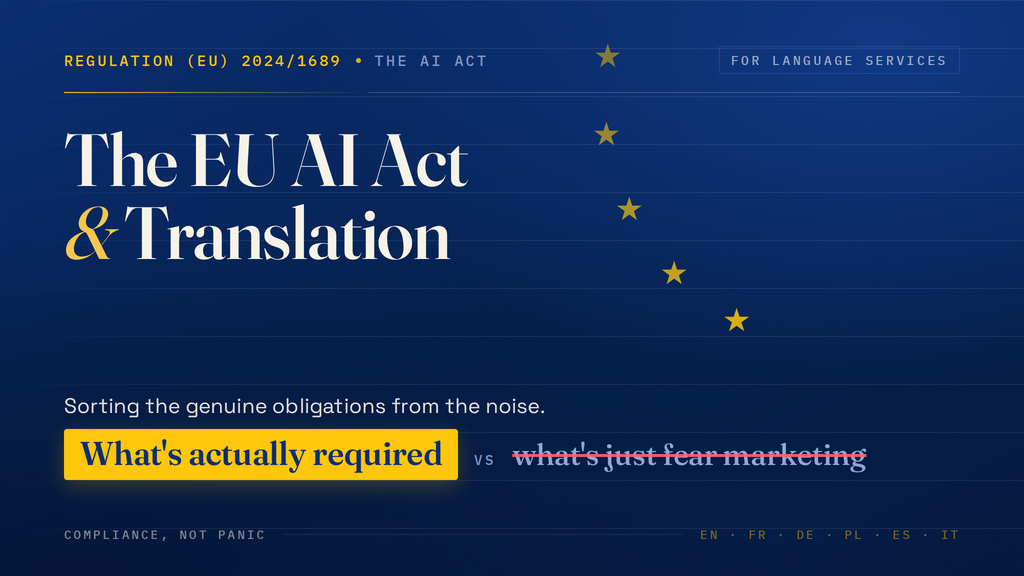
The EU AI Act and Translation: What’s Actually Required (and What’s Just Fear Marketing)
16.06.2026
If you buy translation services for a living, your inbox has probably filled up with some version of this message: "Under the EU AI Act, a mistranslation is now a legal error. You must prove how your AI was trained. The deadline is coming."
It's effective marketing. It's also, in most cases, wrong — or at least so oversimplified that it points buyers toward the wrong preparations. As a language services provider that works daily with regulated industries, we think our clients are better served by accuracy than by anxiety. So here is what the EU AI Act actually says about translation, who carries which obligations, and what a sensible localization buyer should genuinely do about it.
The short answer
Translation is not a high-risk AI category under the EU AI Act. Training-documentation obligations fall on the providers of general-purpose AI models, not on translation buyers or, in most cases, their language service providers. The headline high-risk deadlines were postponed in May 2026: stand-alone high-risk systems must comply by December 2, 2027, and AI embedded in regulated products by August 2, 2028. The genuine obligations relevant to translation buyers — documented human oversight, data protection, and supply-chain due diligence — are best met through certified processes such as ISO 18587, ISO 27001, and ISO 13485.
First, the timeline everyone keeps getting wrong
The EU AI Act entered into force on August 1, 2024, with obligations phasing in over several years. The dates that matter most:
February 2025: Prohibited AI practices and AI literacy obligations began to apply.
August 2025: Obligations for providers of general-purpose AI models (the companies that build large language models) took effect.
August 2, 2026: Originally the big one — the date high-risk AI system obligations were set to apply. This is the deadline most fear-based marketing is built on.
The part the scary emails leave out: in May 2026, EU lawmakers reached political agreement on the so-called Digital Omnibus, postponing high-risk obligations. Stand-alone high-risk systems (Annex III) now have until December 2, 2027; AI embedded in regulated products such as medical devices (Annex I) has until August 2, 2028. Formal adoption is expected over the summer of 2026.
In other words: the "deadline" being invoked to rush you into purchasing decisions was deferred by 16 months or more, precisely because the technical standards companies need in order to comply aren't finished yet. Anyone telling you the courtroom door swings open in August 2026 hasn't read the news since spring.
Is translation a "high-risk" AI use? Almost never.
The AI Act regulates by risk category. The high-risk list (Annex III) covers AI used in sensitive domains: biometrics, critical infrastructure, education, employment and worker management, access to essential services, law enforcement, migration and border control, and the administration of justice.
Notice what's not on that list: translation. Machine translation, AI-assisted translation, and computer-aided translation tools are not, by themselves, high-risk AI systems under the Act. Using AI to translate your website, your marketing materials, your software interface, or your internal documentation does not place you in the high-risk regime — and does not trigger an obligation to "prove how the AI was trained."
That training-documentation obligation exists, but it sits with providers of general-purpose AI models — the organizations that build and place large models on the EU market. If you buy translations, you are not that. In most scenarios, even your language services provider is not that.
Where translation does intersect with the Act
None of this means the Act is irrelevant to localization. There are three genuine intersection points worth understanding:
1. Translation embedded in high-risk systems. If translated content is a functional component of a regulated product or high-risk system — the interface and instructions of a medical device, an AI-driven hiring platform operating across languages, systems used in asylum and border procedures — then the translation inherits the compliance context of the system it lives in. The legal obligations fall primarily on the provider and deployer of that system, but they will flow down to suppliers in the form of quality, traceability, and documentation requirements. If you're in medtech, you already know this dynamic: it's how MDR and ISO 13485 have worked for years. The AI Act extends the logic, it doesn't invent it.
2. Transparency obligations. Certain transparency duties — informing people when they are interacting with AI, labeling AI-generated content in specific contexts — begin applying from August 2026. For most translation buyers these are light-touch, but they reinforce a direction of travel: organizations need to know, and be able to say, where AI was used in producing their content.
3. AI literacy and vendor due diligence. Since early 2025, organizations using AI systems are expected to ensure adequate AI literacy among staff. In practice, procurement and compliance teams are responding by asking vendors harder questions: What AI do you use? Where does our data go? Who reviews the output? Can you document the process? These questions are often not strictly required by the Act for translation work — but they are entirely reasonable, and they are becoming standard in regulated-industry RFPs.
The liability point, stated honestly
"A mistranslation can follow you into a courtroom" was true long before anyone drafted the AI Act. A wrong dosage instruction on a medical device, a mistranslated contract clause, an inaccurate safety warning — these have always carried contractual and regulatory liability. What has changed is not the existence of liability but the scrutiny of process: when something goes wrong and AI was involved, the first question is now "what was your human oversight?"
That is the real, durable lesson for translation buyers — and it has very little to do with deadlines. Unreviewed machine output in high-stakes content was a bad idea in 2020, is a bad idea in 2026, and will still be a bad idea in 2028. The AI Act simply makes it harder to pretend otherwise.
What a sensible buyer should actually do
Skip the panic purchases. Do these four things instead:
Map your content by risk, not by volume. Marketing copy, support articles, and UI strings carry different stakes than IFUs, clinical documentation, legal contracts, or safety information. Your AI policy should follow the risk, not apply one rule to everything.
Require documented human oversight where it matters. For high-stakes content, machine translation should only ever appear inside a certified human post-editing workflow. ISO 18587 is the international standard for exactly this: it defines the process, the qualifications of post-editors, and the documentation trail. If your vendor uses AI without an ISO 18587-certified process behind it, you have a process gap — AI Act or no AI Act.
Ask where your data goes. The most immediate legal risk in AI translation isn't the AI Act at all — it's GDPR and confidentiality. Free or consumer-grade MT tools may retain and train on your content. Your vendor should be able to show information-security certification (ISO 27001) and explain precisely how client content is handled.
For regulated products, align translation with your existing quality system. If you're a medical device manufacturer, your translation supplier should already operate under ISO 13485-aligned processes. The Act's product-embedded AI rules (now arriving in 2028) will be absorbed into that same machinery — it's an extension of quality management you already do, not a new universe.
The bottom line
The EU AI Act is a serious piece of regulation, and its direction is clear: AI use must come with transparency, human oversight, and documentation. But for translation buyers, the honest summary is this: you are not required to prove how anyone's AI was trained; translation is not a high-risk AI category; the headline deadlines just moved to late 2027 and 2028; and the things genuinely worth doing — risk-mapping your content, demanding certified human-in-the-loop processes, and protecting your data — were worth doing before the Act and will remain worth doing after it.
Choose vendors who tell you that plainly, rather than those who need you frightened to win your business.
Frequently asked questions
Is translation a high-risk AI use under the EU AI Act?
No. Machine translation and AI-assisted translation are not listed in Annex III. Translation only inherits high-risk obligations when embedded in a high-risk system or regulated product — for example, the multilingual interface of a medical device or an AI-driven hiring platform.
Do I have to prove how my translation vendor's AI was trained?
No. Training-documentation duties sit with providers of general-purpose AI models. As a translation buyer you are a deployer at most, with far lighter obligations. What your compliance team will reasonably want instead is documentation of human oversight and data handling — which is a vendor-selection question, not an AI Act filing.
When do the high-risk rules actually apply?
Following the Digital Omnibus agreement of May 2026: December 2, 2027 for stand-alone high-risk systems (Annex III) and August 2, 2028 for AI embedded in regulated products (Annex I). The widely cited August 2026 deadline no longer applies to high-risk obligations, though certain transparency duties do begin in 2026.
What is ISO 18587 and why does it matter here?
ISO 18587 is the international standard for full human post-editing of machine translation output. It defines the workflow, the qualifications of post-editors, and the documentation trail — which makes it the most direct, auditable answer to the question regulators and compliance teams actually ask: "what was your human oversight?"
LingPerfect Translations supports organizations in 200+ languages with certified human-in-the-loop AI translation workflows. We hold ISO 18587 (machine translation post-editing), ISO 13485 (medical devices), ISO 17100 (translation services), ISO 27001 (information security), and ISO 9001 (quality management) certifications, and we're a Disability:IN certified diverse supplier. If your compliance team has questions about AI in your localization supply chain, talk to us — we'll give you the accurate version.
Dive into the fascinating world of Portuguese language variations! Discover the unique differences between Brazilian Portuguese and European Portuguese with our in-depth exploration. Uncover insights, tips, and cultural nuances to enhance your language skills today. Exploring Portuguese Language Variations: Brazil vs. Europe As the sixth most spoken language globally, Portuguese connects over 260 million people across different continents, including […]
Explore the fascinating differences between Canadian French and European French in communication. Discover how linguistic nuances can shape understanding and connection in diverse cultural contexts. Ah, French – a language of love, diplomacy, and international relations, blossoming differently across continents. When we talk about the French language, what often comes to mind is its elegance, but did you know […]
Delve into the rich history and ongoing advancements in machine translation over the past 90 years. Explore the evolution of this transformative technology that continues to shape global communication and understanding. Embrace the power of language with our cutting-edge translation solutions. In today’s world, it’s rare to encounter someone who hasn’t heard of Google Translate or machine translation. The general […]
LingPerfect Translations, Inc. sets the standard for excellence in translation services. With our recent achievement of ISO 27001 certification, we guarantee the highest level of data security and confidentiality. Trust us to handle your sensitive information with utmost care and precision.
Planning a virtual meeting with an interpreter? Learn how to effectively utilize translation services to facilitate communication and bridge language barriers during your virtual meetings.
Break language barriers and unlock global success with our expert translation and localization services. Our team of language experts ensures accurate and culturally relevant translations, giving your business a competitive edge in international markets. Discover how we can help you expand your reach today.
Do you need an interpreter or a translator for your next business meeting? Here’s a breakdown of the key differences between these two types of professionals.
If you buy translation services for a living, your inbox has probably filled up with some version of this message: “Under the EU AI Act, a mistranslation is now a legal error. You must prove how your AI was trained. The deadline is coming.” It’s effective marketing. It’s also, in most cases, wrong — or […]